VR GuShi
VR GuShi is a VR educational prototype to learn poetry in Cantonese
developed for buddhist school Po Kok Primary School in Hong Kong. ‘GuShi’ means ancient poetry. Target users are students aged 9-11, English speaking ethnic minorities who are from Sri Lanka, Cambodia and the Philippines. This game is developed as an educational supplement, aiming to visually anchor the children’s impression of the Chinese characters, as well as comprehend the linguistic differences between English and Chinese.
‘Chun Hiu’ means ‘Spring Dawn’. It is a tang dynasty poem we learn as children growing up. Through ancient Chinese poetry, we learn the characters and the basis of Chinese linguistics. Unlike English, where it is phonetic; Chinese language emerges almost like a pictorial latin. Each character has its own meaning, and when strung together, it paints a picture. And in this poem, the picture is of a spring morning, where the poet wakes up, looks at the flowers, and aches for the passing of time.
~ Welcome to Meng Haoran’s mountain cabin. Meng Haoran is a Tang Dynasty Chinese poet. Here, he writes poems when inspiration strikes. Today we will be learning one of his most famous poems ‘Chun Hiu’. The poem describes waking up to a beautiful spring morning, where he recalls last night fallen flowers and aches for the seasons and passing time. ~
‘Chun Hiu’ means ‘Spring Dawn’. It is a tang dynasty poem we learn as children growing up. Through ancient Chinese poetry, we learn the characters and the basis of Chinese linguistics. Unlike English, where it is phonetic; Chinese language emerges almost like a pictorial latin. Each character has its own meaning, and when strung together, it paints a picture. And in this poem, the picture is of a spring morning, where the poet wakes up, looks at the flowers, and aches for the passing of time.
~ Welcome to Meng Haoran’s mountain cabin. Meng Haoran is a Tang Dynasty Chinese poet. Here, he writes poems when inspiration strikes. Today we will be learning one of his most famous poems ‘Chun Hiu’. The poem describes waking up to a beautiful spring morning, where he recalls last night fallen flowers and aches for the seasons and passing time. ~
IDEATE
The poem ‘Chun Hiu’ means Spring Dawn, which describes the poet Mang Haoren’s melancholy upon waking up on a spring morning. The idea is that the poet is inspired by objects in his environment to write the poem. So the user would scan the environment which would trigger a line of poem that consists of 5 characters in bubbles to float inside his cabin.On hover for each character, we hear it’s cantonese pronunciation as well as see it’s English translation. An English translation of full sentence is below the bubbles, and it is up to the user to match the bubbles into words and then into a full sentence.
Once the matched bubbles create a full sentence, it drops down and appears as a calligraphic sentence on a scroll. Then the user would scan the environment to trigger the next set of bubbles.
ITERATION 1
The first iteration of game design included a splash screen and a menu to prepare for future poems were eventually discarded so that users can focus on the gameplay. 
ITERATION 2
The second to last iteration of game design included a UI bar underneath with an audio button. The idea is that when the character bubbles are correctly matched, the bubbles drop down and appear as Chinese callgraphy on the scroll, as if written by the poet himself.
ITERATION 3
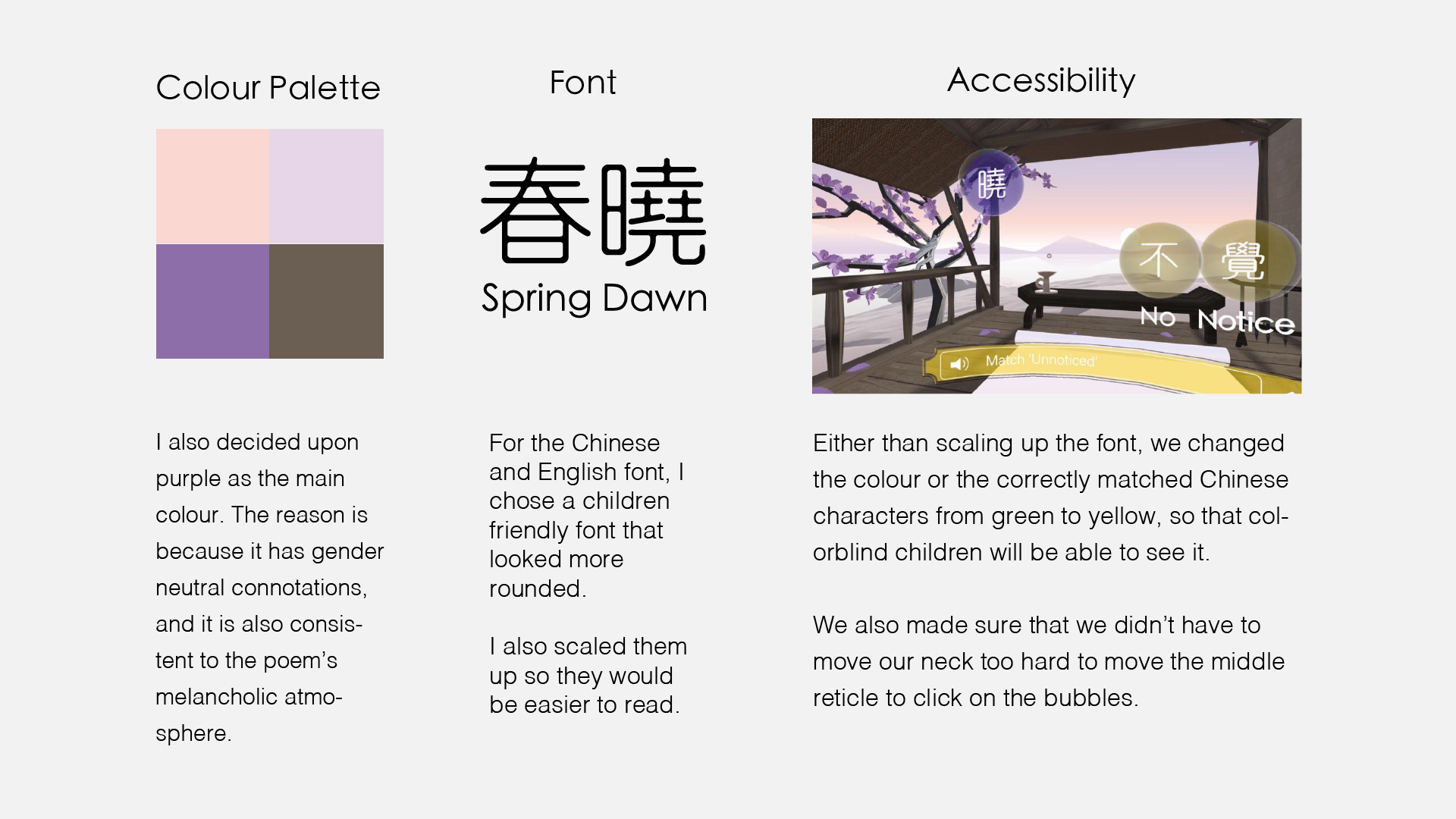
The audio button is discarded in the UI bar, so that when the user hovers over the buttons it makes the Cantonese pronunciation of the character. Colors were also added to the bubbles to indicate whether the bubbles are correctly matched. 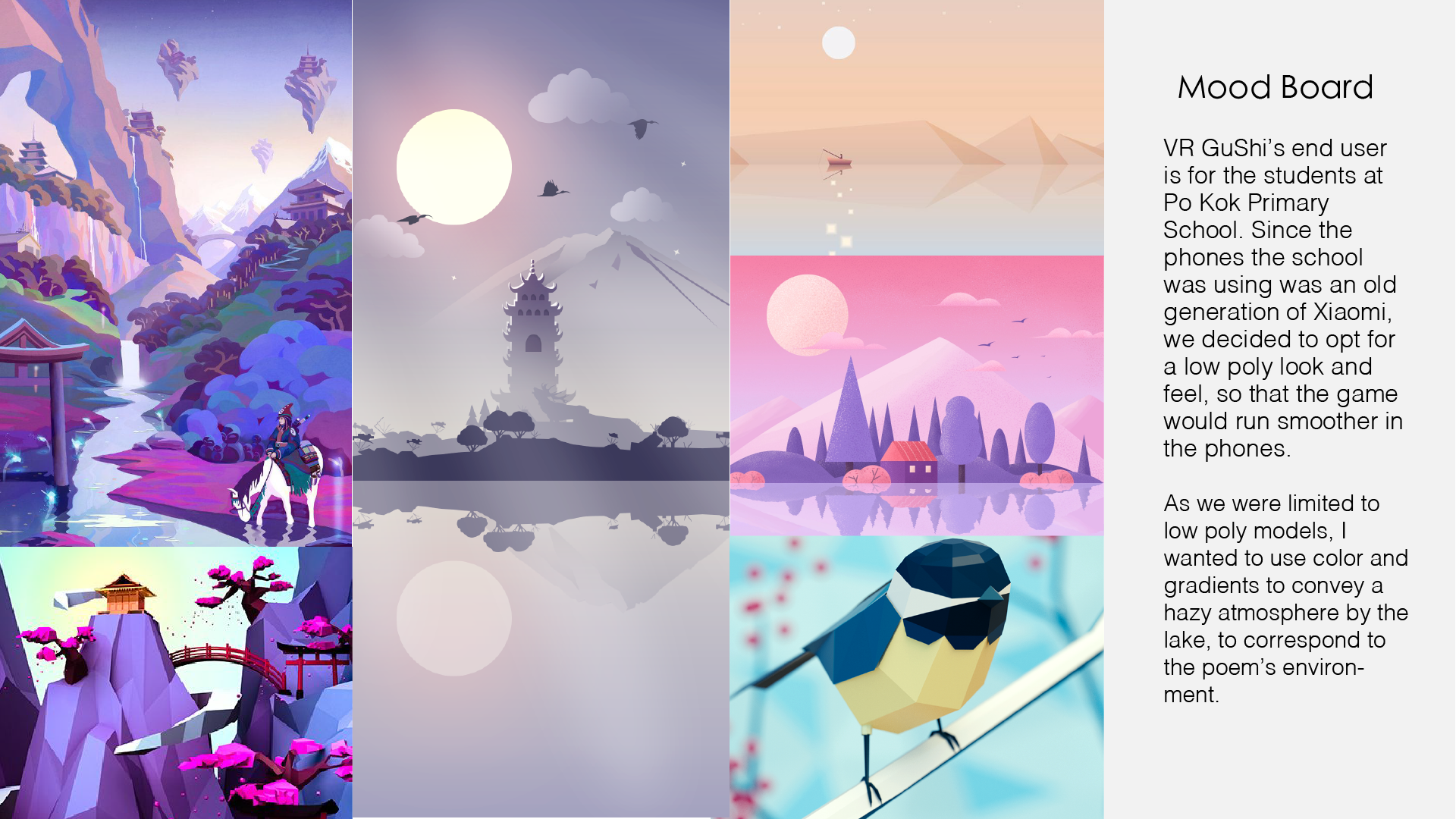
FINAL ITERATION
We upgraded the game from gaze click controller (Google Cardboard) to hand held controllers (Meta Quest 2/3s) for a more intuitive user interface, so that users won’t have to crane their neck to match the bubbles.Initially the user would scan the environment to trigger game play, but the users had trouble identifying what to click on. So we added animations on the game objects as a suggestion to encourage game play.
We also changed the sentence structure of the English translation so that target users are not confused by the grammatical structure and can match the bubble’s meaning to the sentence in a linear fashion.
Available on Meta Quest 2/ 3s.
Client: Po Kok Primary School
Art & Design: Studio 0
UX/ UI Design: Studio 0 | Adrian Van Cooten | Painful Smile
Developer Team: Painful Smile
Music: Primal Future Now Music
© 2025 Studio 0 All Rights Reserved